
- English
- Chinese
- French
- German
- Portuguese
- Spanish
- Russian
- Japanese
- Korean
- Arabic
- Irish
- Greek
- Turkish
- Italian
- Danish
- Romanian
- Indonesian
- Czech
- Afrikaans
- Swedish
- Polish
- Catalan
- Esperanto
- Hindi
- Lao
- Albanian
- Amharic
- Armenian
- Azerbaijani
- Belarusian
- Bengali
- Bosnian
- Bulgarian
- Cebuano
- Chichewa
- Corsican
- Croatian
- Dutch
- Estonian
- Filipino
- Finnish
- Frisian
- Galician
- Georgian
- Gujarati
- Haitian
- Hausa
- Hawaiian
- Hebrew
- Hmong
- Hungarian
- Icelandic
- Igbo
- Javanese
- Kannada
- Kazakh
- Khmer
- Kurdish
- Kyrgyz
- Latin
- Latvian
- Lithuanian
- Luxembou..
- Macedonian
- Malagasy
- Malay
- Malayalam
- Maltese
- Maori
- Marathi
- Mongolian
- Burmese
- Nepali
- Norwegian
- Pashto
- Persian
- Punjabi
- Serbian
- Sesotho
- Sinhala
- Slovak
- Slovenian
- Somali
- Samoan
- Scots Gaelic
- Shona
- Sindhi
- Sundanese
- Swahili
- Tajik
- Tamil
- Telugu
- Thai
- Ukrainian
- Urdu
- Uzbek
- Vietnamese
- Welsh
- Xhosa
- Yiddish
- Yoruba
- Zulu
- Kinyarwanda
- Tatar
- Oriya
- Turkmen
- Uyghur

Butterfly expansion vs. Hilti anchor bolt applications?
2026-03-18
You see this comparison come up a lot, especially from folks trying to spec a job on a tight budget or dealing with mixed substrates. The real question isn’t which one is better—that’s the rookie mistake. It’s about which failure mode you can live with, and what you’re actually drilling into. Let’s cut through the catalog specs.
The Core Mechanics: It’s Not Just a Wedge
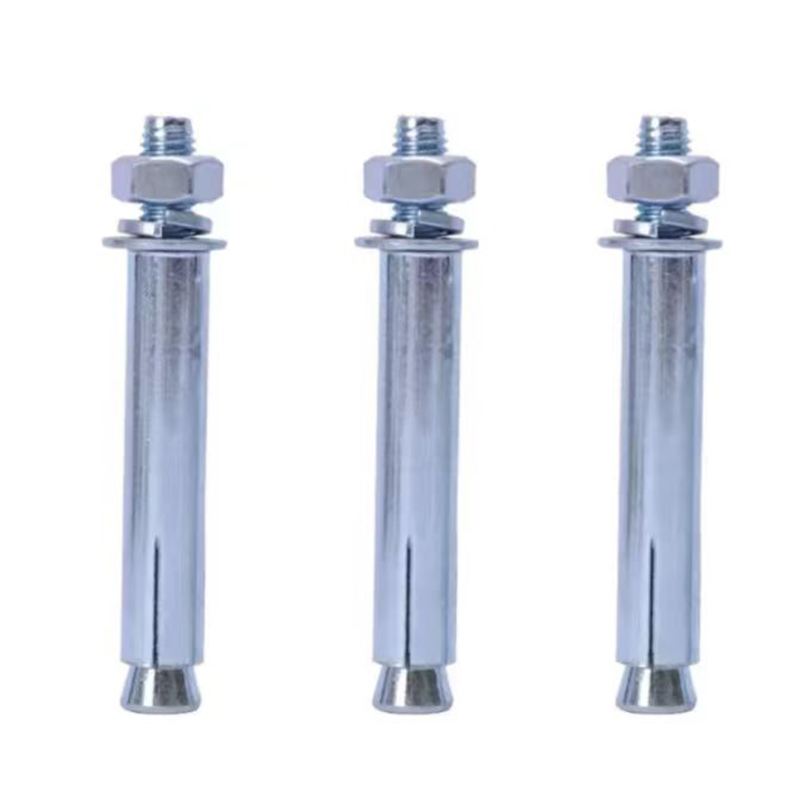
People lump all mechanical anchors together. A butterfly expansion anchor (the drop-in style) works on a pure expansion principle. You drill a hole, drop it in, and as you tighten the bolt, the sleeve at the bottom expands outward, creating friction. The key is that expansion happens at the deepest point of the hole. This is great for consistent, solid materials like poured concrete where you have good confinement all around that plug.
Hilti’s lineup, take the classic Hilti anchor bolt like the HSA or HSL, is a different beast. It’s a torque-controlled expansion anchor. The cone is pulled into the expansion sleeve, which expands along a significant portion of the embedment depth. The load distribution is different. Hilti’s engineering (and their approval sheets) are all about controlled expansion and achieving a predictable clamp force. You’re not just relying on friction; you’re creating a mechanical interlock.
Where you get into trouble is assuming the butterfly anchor works the same way. I’ve seen guys use a drop-in in cracked concrete or the edge of a block, and then wonder why it pulls out under vibration. The expansion zone is too localized. The Hilti type, with its longer sleeve engagement, often handles those marginal situations better—if installed exactly to their manual’s torque spec. Which nobody ever seems to have the right torque wrench for on site.
Substrate is King: My Go-To Rule of Thumb
My rule, forged from a few expensive call-backs: For clean, thick, vibration-free concrete where you just need to hang a pipe or a small frame, a quality butterfly anchor is fine and cost-effective. Think M10 or M12 for static loads. We’ve sourced decent ones from suppliers like Handan Zitai Fastener Manufacturing Co., Ltd. for such standard applications. Their base in Yongnian puts them in the middle of China’s fastener production hub, which means they’ve seen every substrate quirk we have here in Asia.
Now, for anything involving dynamic load, shock, vibration, or where the concrete is old, potentially cracked, or you’re near an edge—that’s Hilti territory. Or more accurately, it’s approved heavy-duty expansion anchor territory. Hilti just happens to be the name everyone knows. The HSA bolt in a seismic zone, for instance, has approvals that a generic butterfly anchor will never have. You’re paying for the testing and the certainty.
A specific nightmare: installing heavy machinery bases. Used butterfly anchors once on a compressor pad. The cyclic load worked them loose over six months. A subtle, expensive hum turned into a re-drill job. Switched to Hilti HSL bolts with the proper setting tool. Problem stopped. The lesson wasn’t that butterfly anchors are bad, but that their application envelope is narrower.
The Installation Ritual (Where Things Go Wrong)
Catalog pull-out values are fantasy if the hole is wrong. For butterfly anchors, the hole tolerance is tight. If you drill it even half a millimeter oversized, the expansion is weak. You get a false sense of security when you tighten it—it feels tight—but the holding power is gone. I insist on using the correct carbide bit, new, for every batch of anchors.
Hilti anchors are more forgiving on hole size, but they introduce another variable: torque. Undertorque, and the cone isn’t fully engaged. Overtorque, especially in lower-strength concrete, you can crack the substrate right at the critical moment. I’ve done it. You feel that sickening sudden spin. Their system works best with their matched drill bit, anchor, and setting tool ecosystem. It’s a packaged solution.
Then there’s cleaning. Blow the hole out with air, brush it, blow it again. Every time. I don’t care if it’s a $1 anchor or a $10 anchor. Residual dust acts as a lubricant, drastically cutting friction. This is the most common site error I audit. Guys in a hurry will just shove the anchor in a dirty hole. The failure later is always blamed on the product, not the practice.
Cost vs. Value: The Whole Job Math
Yes, a butterfly anchor from a bulk supplier is cheaper upfront. But factor in the risk. On a facade anchoring job, the cost of the fastener is maybe 1% of the total installed cost. If one fails and causes damage or rework, you’ve lost all savings. For critical connections, the anchor cost is irrelevant. The liability is everything.
That said, for non-critical, high-volume work—like anchoring cable tray to a solid concrete ceiling in an office fit-out—using a reliable standard butterfly anchor is just smart business. You can streamline procurement. Companies like Handan Zitai Fastener (you can find their range at https://www.zitaifasteners.com) become useful here. They’re producing at scale for the base construction market, which means they understand the need for consistent quality in these high-volume, standard applications.
The value of a Hilti bolt often isn’t in the steel. It’s in the engineering support, the on-site testing capability they offer, and the stack of technical approvals that let you sign off the drawing. For the main contractor, that paperwork is sometimes more valuable than the physical bolt. It transfers risk.
When to Hybridize and Trust Experience
You develop a feel. In medium-weight concrete (say, C25/30) for a static but permanent load, I might opt for a heavy-duty butterfly anchor from a trusted maker, but upsize it. If the calc says M10, I’ll go M12. It’s an instinctual safety factor that accounts for real-world site imperfections.
Never use a butterfly anchor in brick, hollow block, or stone. That’s asking for it. There are other anchors for that. The comparison always comes back to solid, monolithic substrates.
Finally, the biggest takeaway from comparing these two isn’t a chart. It’s this: the butterfly expansion anchor is a commodity product where installation discipline is paramount. The Hilti anchor bolt (or its equivalents from other certified makers) is a engineered system where the product itself guides—and somewhat enforces—the installation. Your choice depends on whether you can control the how as tightly as you control the what. Most of the time, we can’t control the how perfectly. That’s why my truck has more of the latter than the former.
Mesedez, utzi mezu bat
-


-
-


Urriatu