- English
- Chinese
- French
- German
- Portuguese
- Spanish
- Russian
- Japanese
- Korean
- Arabic
- Irish
- Greek
- Turkish
- Italian
- Danish
- Romanian
- Indonesian
- Czech
- Afrikaans
- Swedish
- Polish
- Basque
- Catalan
- Esperanto
- Hindi
- Lao
- Albanian
- Amharic
- Armenian
- Azerbaijani
- Belarusian
- Bengali
- Bosnian
- Bulgarian
- Cebuano
- Chichewa
- Corsican
- Croatian
- Dutch
- Estonian
- Filipino
- Finnish
- Frisian
- Galician
- Georgian
- Gujarati
- Hausa
- Hawaiian
- Hebrew
- Hmong
- Hungarian
- Icelandic
- Igbo
- Javanese
- Kannada
- Kazakh
- Khmer
- Kurdish
- Kyrgyz
- Latin
- Latvian
- Lithuanian
- Luxembou..
- Macedonian
- Malagasy
- Malay
- Malayalam
- Maltese
- Maori
- Marathi
- Mongolian
- Burmese
- Nepali
- Norwegian
- Pashto
- Persian
- Punjabi
- Serbian
- Sesotho
- Sinhala
- Slovak
- Slovenian
- Somali
- Samoan
- Scots Gaelic
- Shona
- Sindhi
- Sundanese
- Swahili
- Tajik
- Tamil
- Telugu
- Thai
- Ukrainian
- Urdu
- Uzbek
- Vietnamese
- Welsh
- Xhosa
- Yiddish
- Yoruba
- Zulu
- Kinyarwanda
- Tatar
- Oriya
- Turkmen
- Uyghur


10.9S large hex bolt innovations?
2026-02-22
- 10.9S Large Hex Bolt Innovations: Beyond the Spec Sheet
- The Misunderstood Core: What 10.9S Really Demands
- Head & Bearing Surface: Where Geometry Meets Function
- The Thread Rolling Revolution: It’s All About the Roots
Thread forming is where fatigue life is often made or broken. Cold rolling after heat treatment (versus cutting or rolling before) is the gold standard for 10.9S fasteners. It work-hardens the surface, creates a smooth, continuous grain flow, and most importantly, compresses the root radius. A sharp root is a crack initiation point. Modern, CNC thread rollers allow for exquisite control over this radius profile.
The real-world impact? I’ve looked at comparative fatigue test data for bolts from manufacturers who invest in premium rolling dies versus those who don’t. The difference in cycles-to-failure under alternating stress can be an order of magnitude. For a client, specifying a bolt that mentions ‘post-heat-treatment rolled threads’ is often more valuable than just the grade. It’s a detail that separates a commodity from a component.
One persistent issue, though, is thread galling, especially with stainless counterparts or during dry installation. Innovations here are less about the bolt alone and more about the system: integrated dry lubricants in the coating, or molybdenum-disulfide-based patches applied at the factory. They add a step, but they prevent site headaches that can blow a project schedule.
Logistics & Traceability: The Unsexy Backbone
- Failed Experiments and Pragmatic Compromises
10.9S Large Hex Bolt Innovations: Beyond the Spec Sheet
When you hear ‘10.9S large hex bolt innovations,’ most minds jump straight to material science—better alloys, higher tensile. That’s the common trap. The real story, the one that matters on the shop floor or at a wind farm base, isn’t just about hitting that 1040 MPa minimum tensile strength. It’s about everything that happens around it to make that spec reliable, installable, and cost-effective in the real world. The innovation is often in the process, the testing, and frankly, in solving problems you only discover when you’ve shipped a few million pieces.
The Misunderstood Core: What 10.9S Really Demands
Let’s be clear: achieving the 10.9S property class is a baseline, not the finish line. The ‘S’ denoting a bolt for structural steel connections is crucial—it brings in mandatory Charpy V-notch impact testing requirements. I’ve seen batches pass tensile tests with flying colors but fail miserably at -20°C impact toughness. The innovation here isn’t a secret steel recipe; it’s the rigorous, often overlooked, process control from spheroidize annealing of the wire rod through to the final quenching media agitation. Companies that get this right, like Handan Zitai Fastener Manufacturing Co., Ltd. in that massive Yongnian production base, aren’t just selling bolts; they’re selling consistency. Their location’s logistical advantage near major transport arteries means they can handle bulk structural orders where traceability and batch-to-batch uniformity are non-negotiable.
Where we’ve seen real movement is in the heat treatment line. Moving beyond basic tempering furnaces to continuous, computer-controlled processes that monitor temperature gradients within the load itself. It sounds minor, but it’s the difference between a bolt that’s 10.9S on paper and one that performs like it under dynamic, seismic, or fatigue loading. The goal is eliminating the ‘soft core’—a nightmare scenario where the surface hardness checks out, but the core microstructure hasn’t transformed fully.
Then there’s the decarburization battle. For large hex bolts, especially M24 and up, surface decarb can silently rob you of fatigue life. The innovation has been in protective atmosphere furnaces or using feedstock with a controlled scale that acts as a barrier during heating. It’s a cost adder, but skipping it is a gamble on long-term integrity. I recall a bridge project years back where premature failure in a handful of bolts was traced back to excessive decarb; the fix wasn’t a ‘stronger’ bolt, but a more carefully manufactured one of the same grade.
Head & Bearing Surface: Where Geometry Meets Function
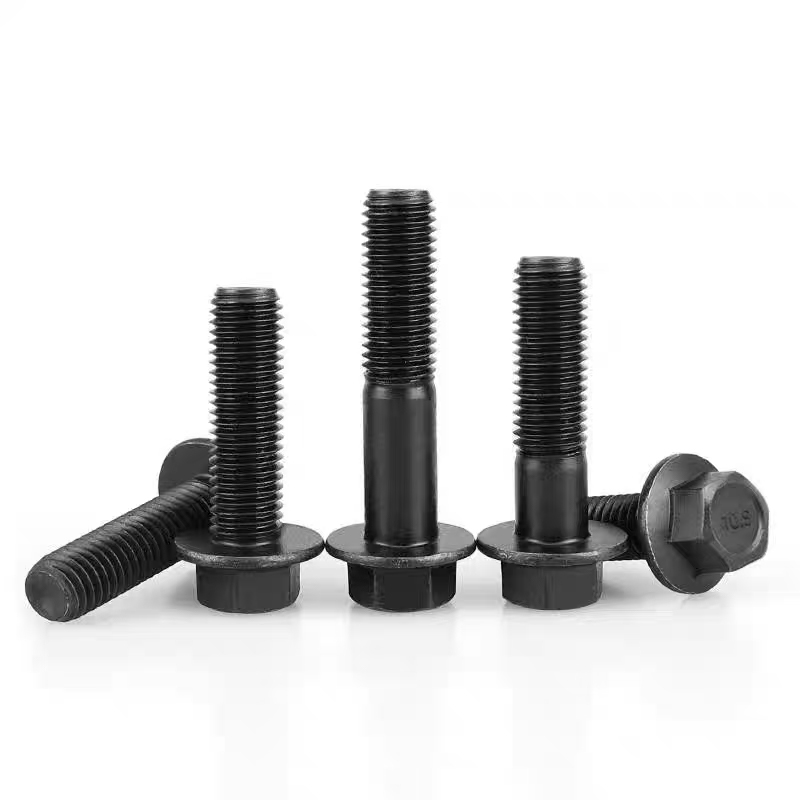
The hex head itself is a quiet arena for improvement. The drive feature is critical. We’re past the era of tolerating rounded-off corners during high-torque installation. The push for higher, more consistent flank angles and precise across-flats dimensions isn’t about looks; it’s about ensuring the socket tool engages fully, distributing stress and preventing cam-out. For large bolts, a slipped tool isn’t just an annoyance—it’s a safety hazard and can gall the head, compromising later inspections.
More significant is the bearing surface under the head. The standard finish—hot-dip galvanizing—creates a thickness issue that affects clamp load. The classic workaround is over-tapping holes, but that’s a field fix. The proactive innovation is in providing large hex bolt products with a consistently controlled galvanized layer or offering alternative coatings like mechanically applied zinc flake systems (e.g., Geomet) that offer superb corrosion resistance without the dimensional challenges. These systems also handle the hydrogen embrittlement risk better during plating, a critical concern for 10.9S and above.
We’re also seeing more demand for integrated solutions: a bolt supplied with a pre-assembled, serrated bearing washer. This isn’t new, but the precision in the serration pitch and depth to bite into galvanized steel without shredding the coating is better now. It solves rotation-resistance more elegantly than a separate washer and a hope.
The Thread Rolling Revolution: It’s All About the Roots
Thread forming is where fatigue life is often made or broken. Cold rolling after heat treatment (versus cutting or rolling before) is the gold standard for 10.9S fasteners. It work-hardens the surface, creates a smooth, continuous grain flow, and most importantly, compresses the root radius. A sharp root is a crack initiation point. Modern, CNC thread rollers allow for exquisite control over this radius profile.
The real-world impact? I’ve looked at comparative fatigue test data for bolts from manufacturers who invest in premium rolling dies versus those who don’t. The difference in cycles-to-failure under alternating stress can be an order of magnitude. For a client, specifying a bolt that mentions ‘post-heat-treatment rolled threads’ is often more valuable than just the grade. It’s a detail that separates a commodity from a component.
One persistent issue, though, is thread galling, especially with stainless counterparts or during dry installation. Innovations here are less about the bolt alone and more about the system: integrated dry lubricants in the coating, or molybdenum-disulfide-based patches applied at the factory. They add a step, but they prevent site headaches that can blow a project schedule.
Logistics & Traceability: The Unsexy Backbone
For a fabricator sourcing thousands of large hex bolts for a single project, the physical handling and paperwork are huge. Innovations in packaging—like stackable, returnable plastic pallets that protect threads and allow for robotic handling—save more man-hours than you’d think. It’s a practical, cost-saving evolution.
Traceability is now non-negotiable. Each batch, even each bundle, should be traceable back to its melt source and heat treat lot. QR codes on tags or direct part marking (where it doesn’t compromise integrity) are becoming standard. This isn’t marketing; it’s liability and quality management. When an auditor or engineer visits a site, they want to scan a code and see the full pedigree. Manufacturers embedded in major supply chains, like those in the Handan cluster, have had to build this digital infrastructure to stay competitive for international structural projects.
The website https://www.zitaifasteners.com, for instance, reflects this shift. It’s less about glossy brochures and more about providing access to technical data sheets, certificates, and compliance documentation—the stuff a procurement engineer actually needs to approve a purchase.
Failed Experiments and Pragmatic Compromises
Not every idea pans out. There was a push a while back for ‘super bolts’ with complex, multi-part thread designs to increase load distribution. Fantastic in theory, a nightmare for field installation and inspection. The industry largely stepped back. The hex head has survived for a reason: simplicity, tool ubiquity, and ease of verification.
Another was the over-engineering of coatings. We tried specifying ultra-thick, multi-layer polymer coatings for extreme corrosion in offshore environments. They worked, but the thickness variance made torque-tension relationship unpredictable. We reverted to a robust metallized coating with a controlled-thickness topcoat. The lesson: the best innovation is often the one that improves reliability without complicating installation.
Looking ahead, the pressure isn’t just for stronger, but for smarter and more sustainable. Can we use more recycled content in the steel without compromising the rigorous 10.9S properties? Can we streamline manufacturing to cut energy use in heat treatment? These are the next frontiers. The innovations in the 10.9S large hex bolt space are now incremental, holistic, and deeply practical. They’re about delivering that guaranteed performance from the mill, through the fabricator, onto the truck, and into the structure—without any surprises. That’s the real measure of progress.