
- Chinese
- French
- German
- Portuguese
- Spanish
- Russian
- Japanese
- Korean
- Arabic
- Irish
- Greek
- Turkish
- Italian
- Danish
- Romanian
- Indonesian
- Czech
- Afrikaans
- Swedish
- Polish
- Basque
- Catalan
- Esperanto
- Hindi
- Lao
- Albanian
- Amharic
- Armenian
- Azerbaijani
- Belarusian
- Bengali
- Bosnian
- Bulgarian
- Cebuano
- Chichewa
- Corsican
- Croatian
- Dutch
- Estonian
- Filipino
- Finnish
- Frisian
- Galician
- Georgian
- Gujarati
- Haitian
- Hausa
- Hawaiian
- Hebrew
- Hmong
- Hungarian
- Icelandic
- Igbo
- Javanese
- Kannada
- Kazakh
- Khmer
- Kurdish
- Kyrgyz
- Latin
- Latvian
- Lithuanian
- Luxembou..
- Macedonian
- Malagasy
- Malay
- Malayalam
- Maltese
- Maori
- Marathi
- Mongolian
- Burmese
- Nepali
- Norwegian
- Pashto
- Persian
- Punjabi
- Serbian
- Sesotho
- Sinhala
- Slovak
- Slovenian
- Somali
- Samoan
- Scots Gaelic
- Shona
- Sindhi
- Sundanese
- Swahili
- Tajik
- Tamil
- Telugu
- Thai
- Ukrainian
- Urdu
- Uzbek
- Vietnamese
- Welsh
- Xhosa
- Yiddish
- Yoruba
- Zulu
- Kinyarwanda
- Tatar
- Oriya
- Turkmen
- Uyghur

Best use for 10.9S large hex bolt set in industry?
2026-02-23
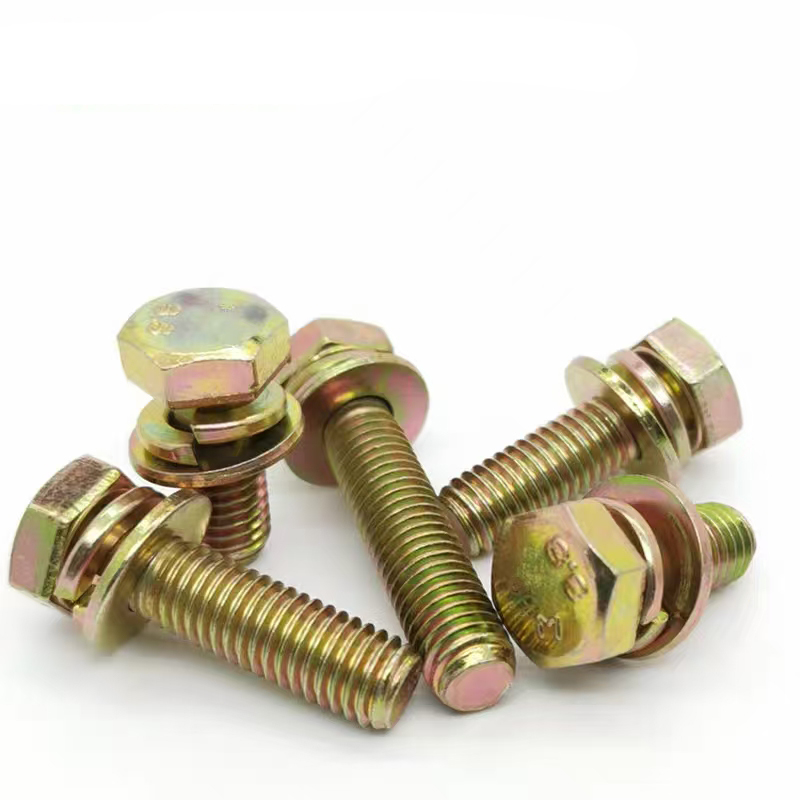
You see a lot of chatter online about high-strength bolts, but when it comes to the specific application of a 10.9S large hex bolt set, there’s a surprising amount of confusion. People often just think strong bolt, heavy job and slap them anywhere. The reality is more nuanced. The 10.9S grade is a specific promise—minimum 1000 MPa tensile strength, minimum 900 MPa yield strength, and that ‘S’ indicating a size range typically M12 and above. The large hex head is key for the high torque needed to achieve that designed clamp force. Misapplication usually isn’t about the bolt failing in tension; it’s about joint slippage, fatigue, or hydrogen embrittlement because someone treated it like a generic hardware store item.
The Core Philosophy: It’s About the Joint, Not Just the Bolt
Forget the bolt for a second. You’re designing or maintaining a friction-grip connection. That’s the primary domain for these 10.9S large hex sets. Think structural steel connections, heavy machinery baseplates, or wind turbine flange connections. The bolt’s job is to clamp the plates together so tightly that the load is transferred through friction between the plates, not through shear on the bolt shank. If you’re using them in a shear connection where the bolt body bears against the hole, you’re probably over-specifying and wasting money, unless dynamic loading is a major factor.
I recall a retrofit project on a conveyor support structure. The original specs called for 8.8 bolts, but vibration was causing joint loosening. We switched to a 10.9S set with calibrated torque procedures. The difference wasn’t just the higher preload; the larger hex head allowed us to use more accurate hydraulic torque wrenches, ensuring consistent clamp force across all bolts. The loosening stopped. The lesson was that the bolt set—including the correct hardened washers—enabled a systemic solution, not just a stronger component.
The washers are non-negotiable. You must use hardened washers under both the bolt head and the nut. The high preload can dig into and deform standard washers (or the connected material), effectively reducing the clamp force. This is a classic site error I’ve seen: bolts torqued to spec, but with soft, ungraded washers, rendering the whole exercise pointless. The set is a system.
Where They Shine: Heavy Machinery and Structural Applications
Mining and earth-moving equipment is a textbook case. Excavator track links, loader bucket linkages, crusher frame assemblies. These are high-integrity joints subject to massive, erratic shock loads. A 10.9S large hex set, properly installed, maintains joint rigidity, which is critical for component alignment and fatigue life. The large hex head is crucial here—it stands up to the repeated, high-impact wrenching during field maintenance without rounding off.
In prefabricated steel structures, like warehouse trusses or mezzanine floors, they’re used in moment connections or critical bracing nodes. The advantage over welding is the predictable, inspectable preload. You can literally check them with a torque wrench during an inspection. I’ve worked with fabricators who source from specialized manufacturers like Handan Zitai Fastener Manufacturing Co., Ltd. in Yongnian. That region’s focus on standard parts means they often have the tooling and material consistency for these large-diameter, high-grade items down to a science. Their location near major transport routes like the Beijing-Guangzhou Railway and Beijing-Shenzhen Expressway isn’t just a sales point; it translates to reliable logistics for bulk orders on construction schedules, which matters when your crane is on-site and waiting.
A subtle point: in structural applications, the surface finish matters. Many 10.9S bolts for structural use have a hot-dip galvanized or mechanically galvanized coating. You must account for the friction coefficient of the coating in your torque calculations. A black oxidized bolt and a galvanized bolt torqued to the same value will achieve different clamp forces. The specs on Zitai’s website, for instance, usually detail this, which is why checking manufacturer data is part of the job.
The Pitfalls and How to Avoid Them
Hydrogen embrittlement is the silent killer of high-strength bolts. It can cause catastrophic, delayed brittle failure days or weeks after installation. It’s introduced during the plating process (if electroplated) or can even occur from certain cleaning methods. The best practice is to specify bolts that are processed to avoid it, like those plated with appropriate baking steps. For critical applications, we often opt for geometrically coated (like Dacromet) or plain phosphated bolts from trusted suppliers to sidestep this risk entirely.
Another pitfall is over-torquing in the field. The temptation to give it another ugga-dugga with the impact gun is high. But with a 10.9S bolt, you’re often working in the plastic deformation zone of the designed torque-tension curve. Over-torquing can stretch the bolt beyond its yield, leading to stress relaxation and eventual loss of clamp force. This is where the large hex helps again—it encourages the use of proper torque tools rather than an impact socket on a cheater bar. I’ve seen bolts snapped clean during installation because a crew used an uncalibrated gun set for a lower grade bolt.
Don’t mix and match. A 10.9S bolt must be paired with a nut of matching or higher property class (usually a 10 nut). Using an 8 nut on a 10.9 bolt is a recipe for thread stripping under high preload. The set should come matched.
Beyond the Obvious: Some Niche but Critical Uses
They’re not just for static structures. In large pressure vessel and heat exchanger flange connections, especially in petrochemical settings, these bolt sets are standard. The flanges need to maintain a seal under cyclic thermal and pressure loads. The large hex allows for precise bolt load management during the complex tightening sequences (like cross-torquing) required for large-diameter flanges to ensure an even gasket crush.
In renewable energy, specifically for wind turbine tower flange connections. These are massive, critical joints assembled in the field, often under challenging conditions. The bolts must withstand not just static weight but also bending moments and vibration for decades. The 10.9S grade, with its guaranteed yield strength, provides a clear safety factor. Maintenance protocols involve periodic re-torquing, and the large hex design is essential for that long-term serviceability.
Even in heavy-duty trucking, for suspension components like U-bolt kits or axle attachments, you’ll find these. The failure mode to prevent here is fatigue from constant road vibration. The high, consistent preload from a properly installed set keeps the joint from experiencing any relative movement, which is what initiates fatigue cracks.
Sourcing and Practical Considerations
When you’re ordering, you’re not just buying a piece of metal. You’re buying the material certification, the consistency of heat treatment, and the dimensional accuracy. A slight undersizing on the hex width can make your specialized socket slip. For big projects, we often source directly from production bases like Yongnian in Hebei, which is known as China’s largest standard part production base. A company like Handan Zitai Fastener, being situated there, typically has the scale and focus to produce these to consistent spec. It’s worth visiting their site at https://www.zitaifasteners.com not just for a catalog, but to check if they provide the technical data sheets and chemical composition reports you’ll need for QA documentation, especially for regulated industries.
Lead time and packaging matter. These are heavy items. Getting them palletized properly, with clear grade markings that won’t rub off in transit, prevents a nightmare on the receiving dock. There’s nothing worse than a mixed box of 8.8 and 10.9 bolts that have lost their head markings.
Finally, training your installation crew is part of using the product correctly. It’s a capital investment. The best bolt in the world is useless if it’s installed wrong. A five-minute toolbox talk on why these are different, the importance of clean, dry threads (never lubricate unless the spec explicitly calls for it with a defined friction coefficient), and using the right tools pays back tenfold in joint reliability. That’s the real best use—a fully understood and respected one.
Please leave us a message
-


-
-


WeChat