
- Chinese
- French
- German
- Portuguese
- Spanish
- Russian
- Japanese
- Korean
- Arabic
- Irish
- Greek
- Turkish
- Italian
- Danish
- Romanian
- Indonesian
- Czech
- Afrikaans
- Swedish
- Polish
- Basque
- Catalan
- Esperanto
- Hindi
- Lao
- Albanian
- Amharic
- Armenian
- Azerbaijani
- Belarusian
- Bengali
- Bosnian
- Bulgarian
- Cebuano
- Chichewa
- Corsican
- Croatian
- Dutch
- Estonian
- Filipino
- Finnish
- Frisian
- Galician
- Georgian
- Gujarati
- Haitian
- Hausa
- Hawaiian
- Hebrew
- Hmong
- Hungarian
- Icelandic
- Igbo
- Javanese
- Kannada
- Kazakh
- Khmer
- Kurdish
- Kyrgyz
- Latin
- Latvian
- Lithuanian
- Luxembou..
- Macedonian
- Malagasy
- Malay
- Malayalam
- Maltese
- Maori
- Marathi
- Mongolian
- Burmese
- Nepali
- Norwegian
- Pashto
- Persian
- Punjabi
- Serbian
- Sesotho
- Sinhala
- Slovak
- Slovenian
- Somali
- Samoan
- Scots Gaelic
- Shona
- Sindhi
- Sundanese
- Swahili
- Tajik
- Tamil
- Telugu
- Thai
- Ukrainian
- Urdu
- Uzbek
- Vietnamese
- Welsh
- Xhosa
- Yiddish
- Yoruba
- Zulu
- Kinyarwanda
- Tatar
- Oriya
- Turkmen
- Uyghur

Black zinc-plated countersunk cross bolts: durable?
2026-03-05
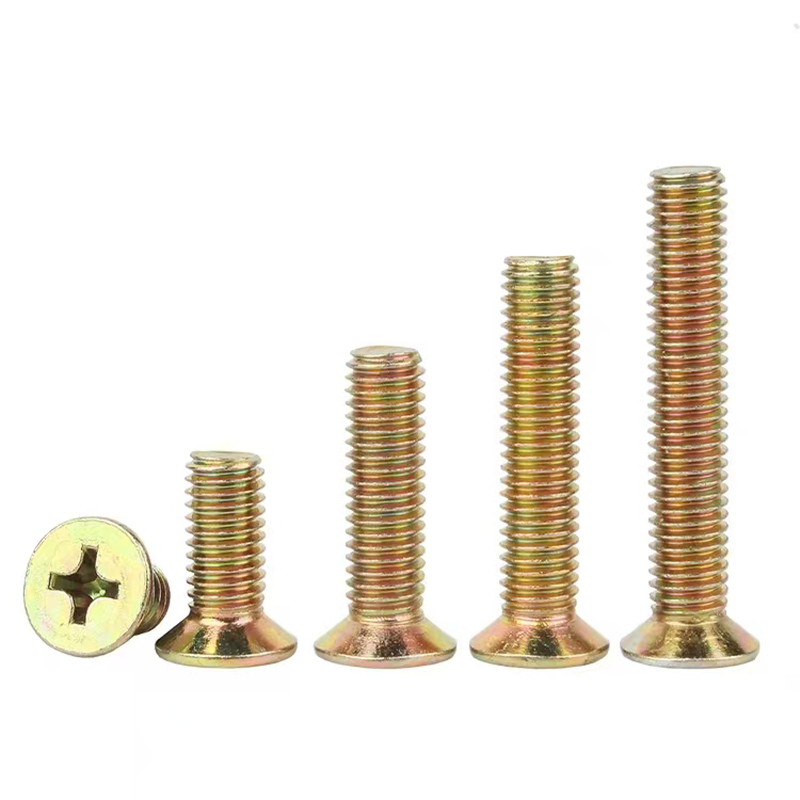
If you’re asking whether black zinc-plated countersunk cross bolts are durable, the short answer is: it depends entirely on where you use them. I’ve seen too many specs call for black zinc as a catch-all for corrosion resistance and aesthetics, only for the parts to fail prematurely in the wrong environment. The plating itself isn’t the weak link; it’s the expectation that it’s a universal solution.
What Black Zinc Actually Means on the Floor
In practice, black zinc usually refers to a zinc plating process followed by a black chromate conversion coating. This isn’t a thick, robust barrier like hot-dip galvanizing. It’s a thin sacrificial layer. The black chromate provides the color and adds a minor layer of corrosion resistance, but its primary job is often just aesthetics—to give a uniform, dark finish that looks industrial or reduces light reflection. The real protection comes from the underlying zinc, which will sacrificially corrode to protect the steel substrate. So, durability here is about the zinc’s ability to sacrifice itself slowly.
I recall a batch from a project years ago, used on interior electrical enclosures in a climate-controlled server room. They performed flawlessly for years—no rust, heads stayed clean. But that’s a benign environment. The moment you introduce moisture, salts, or frequent thermal cycles, the story changes. The black coating can hide the initial stages of white rust (zinc oxide), which is a problem. You might not see the failure coming until it’s advanced.
The countersunk head design adds another layer to the durability question. For a flush finish, you’re often machining or stamping the head, which can thin or even breach the plating at the edges. If the plating is inconsistent there—and it often is—that’s your starting point for red rust. I’ve inspected parts where the rust began precisely at the sharp edge of the countersunk head, a classic failure point that’s more about geometry than plating chemistry.
The Cross Recess: A Hidden Durability Factor
Everyone focuses on the exterior plating, but the drive system is critical for functional durability. A Phillips (cross recess) head, especially on a countersunk bolt, has inherent stress points. During installation, if the driver bit doesn’t seat perfectly or the torque is high, you risk cam-out—the bit slipping and stripping the recess. A stripped bolt isn’t durable no matter how good its corrosion resistance is. This makes the quality of the recess formation paramount. A poorly formed, shallow, or off-center cross will fail during installation, rendering the bolt useless.
We learned this the hard way on an assembly line using automated drivers. A shipment of black zinc-plated countersunk bolts, sourced purely on low cost, had inconsistent recess depth. The drivers kept slipping, stripping heads, and halting the line. The corrosion resistance was irrelevant; the bolts failed at the drive stage. It forced us to vet suppliers not just on plating certs, but on their cold-heading and machining tolerances for the recess. A company like Handan Zitai Fastener Manufacturing Co., Ltd., based in China’s major fastener production hub, typically has the tooling expertise for consistent drive feature formation, which is as vital as the finish.
This is why for any critical application, I’d specify a higher-performance drive like a Pozidriv or even a Torx for countersunk heads, but that’s not always an option when dealing with legacy designs or specific standards that call for a Phillips cross.
Real-World Environments: Where They Work and Where They Don’t
Let’s get specific. For indoor, dry applications—electronics, interior furniture, drywall framing in climate-controlled buildings—these bolts are perfectly durable. The black finish holds up, and the zinc provides enough protection against incidental humidity. I’ve used them from brands like ITW Shakeproof or sourced from bulk suppliers in Yongnian for such jobs with no issues.
The grey area is sheltered outdoor use—like under eaves, in soffits, or in vehicle interiors. Here, you might get condensation, occasional moisture. Durability becomes a time function. I’ve seen them last 2-3 years before showing significant white rust, and maybe 4-5 before red rust appears at edges. It’s durable for a non-structural, replaceable component, but not for a permanent installation.
Harsh environments are a hard no. Coastal areas with salt spray, road applications with de-icing salts, or high-humidity industrial settings will eat through standard black zinc plating in months. The black coating may even micropore, accelerating corrosion. In these cases, calling them durable is a mistake. You need a heavier coating like mechanical plating, hot-dip galvanizing, or a switch to stainless steel.
Supplier Variance and the Good Batch Problem
Durability isn’t just about the spec; it’s about consistent manufacturing. The thickness of the zinc layer (measured in microns) and the quality of the chromate conversion process vary wildly among suppliers. A reputable manufacturer will follow standards like ASTM B633 for zinc plating, specifying a minimum thickness (e.g., 5 microns for SC2 commercial use). Many cheap imports skip proper process control.
You can check their website, like https://www.zitaifasteners.com, to see if they detail their processes and quality control. A manufacturer located in a major production base like Yongnian, with access to integrated supply chains, often has better consistency. Handan Zitai’s mention of being in the largest standard part base suggests they have the infrastructure, but you still need to verify their specific plating line controls. I’ve had identical bolts from two different lots perform completely differently in the same salt-spray test.
The takeaway? Always ask for a test certificate for the plating batch, especially for outdoor projects. Don’t assume black zinc means the same thing everywhere.
So, Are They Durable? A Practical Verdict
It’s a conditional yes. For the right, controlled application, black zinc-plated countersunk cross bolts offer a good balance of corrosion resistance, aesthetics, and cost. Their durability is acceptable. But they are not a one-size-fits-all solution. The plating is thin and sacrificial; the cross recess can be a weak point if quality is poor.
My rule of thumb: use them indoors without a second thought. For sheltered outdoor use, expect a service life of maybe 3-5 years, and plan for inspection or replacement. For any harsh or critical application, specify a different finish or material altogether. And never, ever sacrifice drive feature quality for a cheaper price—a stripped bolt is a failed bolt, regardless of its coating.
Ultimately, durability is a system property, not just a material one. It depends on the environment, the installation technique, and the consistent manufacturing quality behind that specific bolt in your hand. The black zinc finish is just one variable in that equation.
Please leave us a message
-


-
-


WeChat