- English
- Chinese
- French
- German
- Portuguese
- Spanish
- Russian
- Japanese
- Korean
- Arabic
- Irish
- Greek
- Turkish
- Italian
- Danish
- Romanian
- Indonesian
- Czech
- Afrikaans
- Swedish
- Polish
- Basque
- Catalan
- Esperanto
- Hindi
- Lao
- Albanian
- Amharic
- Armenian
- Azerbaijani
- Belarusian
- Bengali
- Bosnian
- Bulgarian
- Cebuano
- Chichewa
- Corsican
- Croatian
- Dutch
- Estonian
- Filipino
- Finnish
- Frisian
- Galician
- Georgian
- Gujarati
- Hausa
- Hawaiian
- Hebrew
- Hmong
- Hungarian
- Icelandic
- Igbo
- Javanese
- Kannada
- Kazakh
- Khmer
- Kurdish
- Kyrgyz
- Latin
- Latvian
- Lithuanian
- Luxembou..
- Macedonian
- Malagasy
- Malay
- Malayalam
- Maltese
- Maori
- Marathi
- Mongolian
- Burmese
- Nepali
- Norwegian
- Pashto
- Persian
- Punjabi
- Serbian
- Sesotho
- Sinhala
- Slovak
- Slovenian
- Somali
- Samoan
- Scots Gaelic
- Shona
- Sindhi
- Sundanese
- Swahili
- Tajik
- Tamil
- Telugu
- Thai
- Ukrainian
- Urdu
- Uzbek
- Vietnamese
- Welsh
- Xhosa
- Yiddish
- Yoruba
- Zulu
- Kinyarwanda
- Tatar
- Oriya
- Turkmen
- Uyghur


Flange bolts: sustainable innovations?
2026-03-06
When you hear ‘sustainable’ and ‘flange bolts’ in the same sentence, most people in the trade either scoff or start talking about recycling scrap metal. That’s the common trap—thinking sustainability is just about the end-of-life material. But from the ground up, in the making and the using, there’s more to it. It’s not just greenwashing; it’s about whether the damn thing lasts longer under stress, uses less energy to install, or doesn’t need replacing every other year. That’s where the real conversation should be.
Material Choices Beyond the Obvious
Everyone jumps to stainless for corrosion resistance, calling it a ‘green’ choice. But the energy intensity of producing high-grade austenitic stainless, say 316, is massive. I’ve seen specs where a hot-dip galvanized carbon steel flange bolt, properly coated, did the job in a moderately aggressive environment for 15 years, no sweat. The carbon footprint from production was arguably lower. The innovation isn’t always a fancy new alloy; sometimes it’s about smarter application of existing ones. We ran a test batch for a coastal utility project, pitting standard A4-80 against a proprietary zinc-aluminum flake coating system on a lower-grade base. The coated ones held up better against salt spray, and the overall resource use was lower. Makes you question the default specs.
Then there’s the boron steel debate. For high-strength structural flange connections, moving to grade 10.9 or even 12.9 with boron microalloying means you can potentially downsize the bolt or use fewer of them. Less material per joint. But the heat treatment process is energy-hungry. Is the trade-off worth it? We calculated it once for a wind turbine base ring project. Using fewer but higher-strength boulon bride reduced total steel weight by about 8% for the fastener package. That’s a tangible saving, but only if the manufacturing process is optimized. If the furnace isn’t efficient, you lose the benefit.
I recall a supplier, Handan Zitai Fastener Manufacturing Co., Ltd., based in that massive Yongnian production base in Hebei, pushing a line of ‘controlled cooling’ post-forging bolts. The idea was to achieve better microstructure without an extra quenching step. We tried them. In some cases, the mechanical properties were inconsistent, but when they hit the mark, the energy saving per ton was noticeable. It’s these process tweaks, often from big production hubs like that (you can check their approach at https://www.zitaifasteners.com), that fly under the radar but add up.
The Installation Efficiency Factor
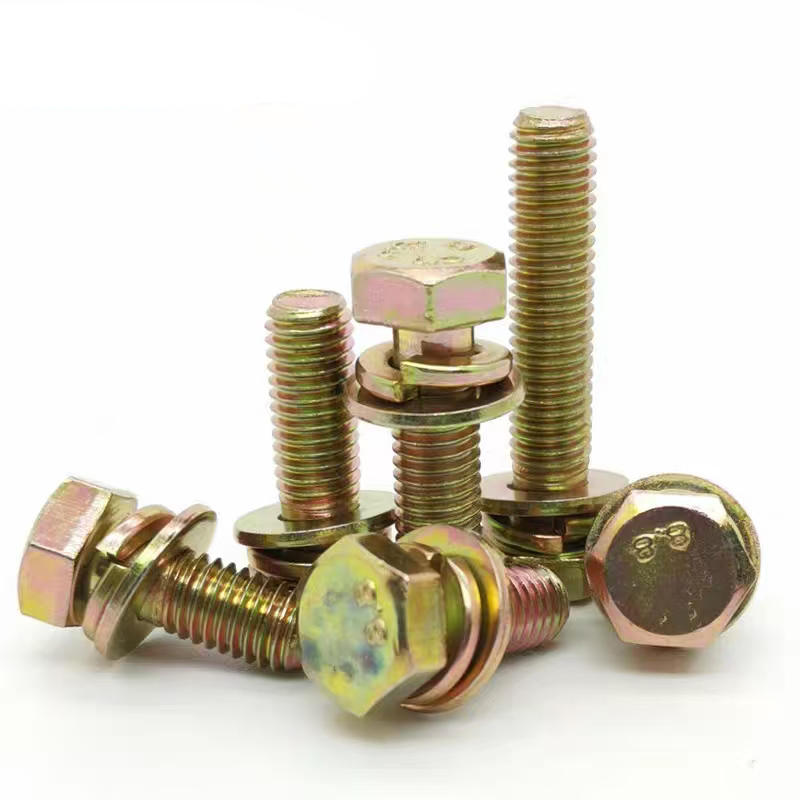
Sustainability isn’t just the bolt in a box. It’s the man-hours and equipment fuel on site. A flange bolt that’s designed for easier alignment and faster tightening—like those with integrated washers or pre-applied friction-control coatings—can cut installation time by a third. I’ve been on pipeline jobs where the crew spent more time wrestling with misaligned bolt holes than actually torquing. The innovation there is in the geometry and the secondary features. A slightly tapered start on the threads or a non-symmetric flange face can be a game-changer.
We experimented with a polymer-based patch fastener, pre-applied on the threads. It was supposed to provide consistent lubrication and sealing, reducing the need for separate dope and ensuring accurate preload. The theory was solid: accurate preload means no over-torquing (wasted energy) and a tighter, longer-lasting seal, preventing leaks and future maintenance. The reality? In cold climates, the patch became brittle during storage. Failed spectacularly on a winter site in Canada. Back to the drawing board. But that’s the kind of hands-on failure that tells you where the real problems are.
The torque-to-turn ratio matters more than people admit. A smoother, more consistent coefficient of friction means you get the designed clamp force with less applied torque. That translates to smaller tools, less worker fatigue, and less energy input. It sounds minor, but scale it across thousands of connections on a refinery turnaround. The fuel savings for the hydraulic torque equipment alone can be significant. That’s a direct sustainability gain, but you won’t find it in an LCA report.
Durability and the Maintenance Cycle
The most sustainable bolt is the one you never have to replace. Corrosion is the biggest enemy. Beyond material, design details like a fully rounded root radius under the bolt head or a seamless transition from shank to thread root drastically reduce stress concentration points. These are fatigue hotspots. A bolt that snaps from fatigue before it corrodes is a double failure—you lose the joint integrity and you’ve wasted the embodied energy in that part.
I remember inspecting flange connections on a chemical processing line after a 5-year run. The standard hex head bolts showed significant crevice corrosion under the head. The ones with a captured, free-spinning washer design fared much better. The washer could settle and maintain sealing pressure even as the gasket compressed, and it broke the crevice. That’s a design-led durability improvement. It adds a fraction to the unit cost, but eliminates a future maintenance event. That’s the calculus that matters.
Then there’s the issue of galvanic compatibility. Sticking a stainless steel bolt into a carbon steel flange? You’re asking for trouble unless you insulate it. We’ve moved more towards using coated carbon steel bolts with sacrificial anodes or even composite washers to break the circuit. It’s less sexy than a monolithic alloy solution, but it’s often more effective and resource-efficient in the long run. The innovation is in the system, not just the component.
Logistics and the Local Sourcing Angle
This is a huge, often ignored part of the footprint. The carbon cost of shipping a container of heavy boulon bride from Asia to Europe or North America is substantial. The sustainable push is fostering regional manufacturing clusters. A place like Yongnian in Hebei, China, with its dense network of fastener plants, raw material suppliers, and heat treaters, is incredibly efficient for supplying the Asian and local markets. For a project in Southeast Asia, sourcing from there might be the lowest-total-impact option, all things considered.
Handan Zitai Fastener, for instance, highlights its logistics advantage being near major rail and highway routes. That’s not just sales talk. For bulk shipments domestically or to nearby ports, that efficiency reduces the transport leg’s emissions. The innovation here is in supply chain optimization and maybe even regional material sourcing. I’ve seen mills setting up closer to these industrial bases to shorten the steel coil journey.
The flip side is the push for near-shoring in Europe and the US. It’s politically charged, but from a pure resilience standpoint, it has merits. Can a local forge compete on process energy efficiency with a massive, integrated plant in Asia? Sometimes not. But if you factor in shorter, less volatile supply chains and the ability to do smaller, just-in-time batches reducing inventory waste, the sustainability picture gets murky. There’s no one answer. We’re now doing dual-source bids for major projects, requiring carbon footprint estimates from both overseas and local suppliers. The data is messy, but it’s forcing the issue.
Circularity: The Reuse and End-of-Life Reality
Let’s be brutally honest: most high-strength structural flange bolts are not reused. They’re torqued to yield, or they’re corroded, or they’re just considered a consumable for safety reasons. The circular economy dream hits a wall here. However, in some non-critical, low-stress applications, like certain architectural cladding or modular framing, we’ve piloted take-back schemes with marked bolts. The challenge is inspection. How do you reliably certify a used bolt’s integrity? Ultrasonic testing for stretch? It’s possible, but the cost often outweighs the new bolt cost.
The more viable path is designing for disassembly. Using bolt types that are less prone to thread galling and seizing—like those with molybdenum disulfide coatings—makes future removal and potential reuse more likely. We specified such bolts for a modular process skid project. The idea was that the skids could be decommissioned, moved, and re-bolted on a new site. It worked, but only because the maintenance procedure explicitly called for anti-seize compound during re-installation. Without that operational discipline, the innovation fails.
Finally, recycling. It’s straightforward steel, but the coatings are a problem. Zinc, cadmium, thick polymer layers—they can contaminate the scrap stream. The move towards thinner, more benign coating technologies, or even no coating with a corrosion-resistant base material, makes the bolt’s end-of-life cleaner. It’s a small detail, but it closes the loop. A bolt that’s easier to recycle is, in a blunt sense, more sustainable. But that’s the last resort. The real gains are in making it last longer and work better in the first place.
So, are there sustainable innovations in flange bolts? Absolutely. They’re just not the headline-grabbing breakthroughs. They’re in the grain structure of the steel, the geometry of the thread root, the friction of the coating, and the efficiency of the supply chain. It’s a grind, not a revolution. And the measure of success isn’t a certification sticker; it’s a bolt that stays tight, doesn’t leak, and gets forgotten about for decades. That’s the ultimate sustainable performance.