
- Chinese
- French
- German
- Portuguese
- Spanish
- Russian
- Japanese
- Korean
- Arabic
- Irish
- Greek
- Turkish
- Italian
- Danish
- Romanian
- Indonesian
- Czech
- Afrikaans
- Swedish
- Polish
- Basque
- Catalan
- Esperanto
- Hindi
- Lao
- Albanian
- Amharic
- Armenian
- Azerbaijani
- Belarusian
- Bengali
- Bosnian
- Bulgarian
- Cebuano
- Chichewa
- Corsican
- Croatian
- Dutch
- Estonian
- Filipino
- Finnish
- Frisian
- Galician
- Georgian
- Gujarati
- Haitian
- Hausa
- Hawaiian
- Hebrew
- Hmong
- Hungarian
- Icelandic
- Igbo
- Javanese
- Kannada
- Kazakh
- Khmer
- Kurdish
- Kyrgyz
- Latin
- Latvian
- Lithuanian
- Luxembou..
- Macedonian
- Malagasy
- Malay
- Malayalam
- Maltese
- Maori
- Marathi
- Mongolian
- Burmese
- Nepali
- Norwegian
- Pashto
- Persian
- Punjabi
- Serbian
- Sesotho
- Sinhala
- Slovak
- Slovenian
- Somali
- Samoan
- Scots Gaelic
- Shona
- Sindhi
- Sundanese
- Swahili
- Tajik
- Tamil
- Telugu
- Thai
- Ukrainian
- Urdu
- Uzbek
- Vietnamese
- Welsh
- Xhosa
- Yiddish
- Yoruba
- Zulu
- Kinyarwanda
- Tatar
- Oriya
- Turkmen
- Uyghur

How do chemical bolts enhance sustainability?
2026-03-09
When you hear ‘sustainability’ in construction, you probably think of solar panels or recycled steel. Chemical anchors? Not so much. That’s the first misconception I had to unlearn on-site. Their role isn’t flashy, but it’s foundational—literally. It’s about the embedded carbon you don’t use, the structures you don’t tear down, and the long-term performance that avoids do-overs. Let’s cut through the greenwash and talk about how these fasteners actually contribute to a more durable and resource-efficient built environment.
Rethinking Material Efficiency and Waste
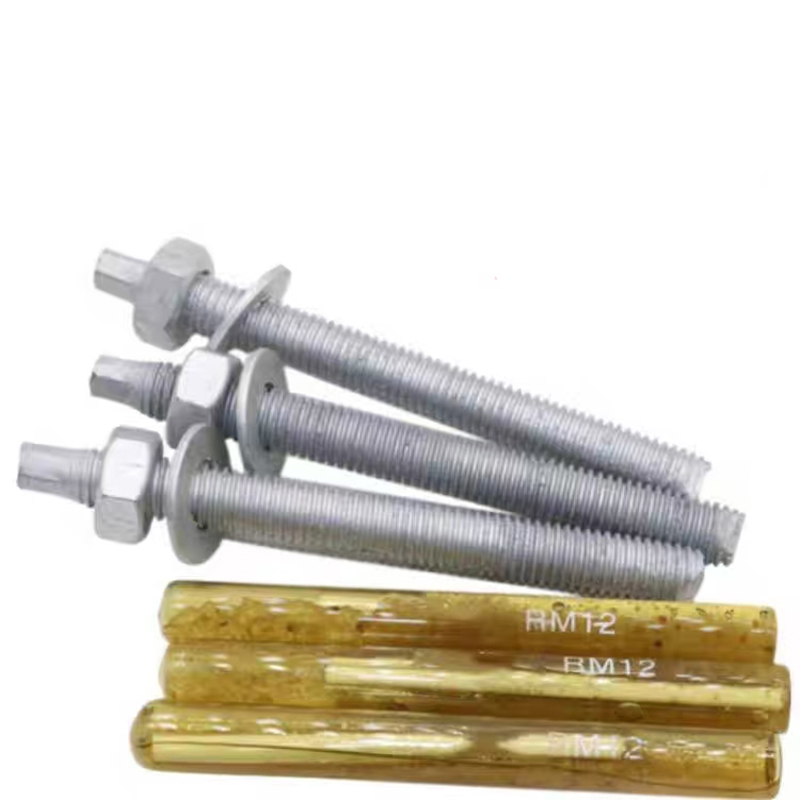
The most direct link is material savings. Traditional mechanical anchors often require oversized baseplates or more frequent fixing points to distribute load, especially in challenging substrates like hollow block or cracked concrete. You end up using more steel. A properly designed chemical fixing, like an epoxy or vinylester-based system, creates a composite action with the base material. This means you can often use fewer, smaller-diameter bolts to achieve the same or higher load capacity. I recall a facade retrofit project where switching to chemical anchors reduced the required anchor points by about 30%. That’s less raw material extracted, processed, and transported. It sounds simple, but in large-scale projects, those numbers add up to significant embodied carbon reduction.
Then there’s the waste stream. Mechanical expansion anchors rely on friction and wedge action, which can cause micro-cracking during installation, sometimes compromising the substrate and leading to future repairs. A failed mechanical anchor often means drilling a new, larger hole nearby—creating concrete dust debris and a useless, patched hole. Chemical systems, when the hole is prepared correctly, fill the void completely and bond without expansive stress. If an installation error occurs before the resin sets, you can usually just clean out the hole and start over. No progressive damage, no wasted substrate material.
But it’s not a perfect swap. You have to consider the cartridge. Most chemical anchors come in two-part glass or plastic ampoules or bulk injection systems. The waste from single-use cartridges is a valid environmental concern. Some suppliers are moving towards recyclable packaging or larger, bulk kits for big jobs to reduce this ratio. It’s a trade-off we’re still navigating. The sustainability gain from material efficiency and longevity often outweighs the packaging waste, but it pushes manufacturers to innovate on that front too.
Extending Structural Life and Enabling Retrofits
This is where chemical bolts truly shine for sustainability: they enable and secure the adaptive reuse of existing structures. Demolition is incredibly carbon-intensive. The greenest building is often the one already standing. We constantly face the challenge of attaching new elements to old, sometimes questionable concrete. Mechanical anchors in aged concrete can be a gamble due to unknown internal stresses and potential for cracking.
I worked on a 1970s office building conversion where the concrete core testing showed variable compressive strength. Using a high-performance chemical anchor system allowed us to securely mount new seismic bracing and service modules without having to core through entire slabs or add massive supplemental framing. The resin consolidates the borehole walls and isn’t as sensitive to minor cracks or porosity. It effectively upgraded the load-bearing capacity of the existing structure at the point of connection, extending the building’s viable life by decades. That’s a massive win for resource conservation.
There’s a learning curve, though. You can’t just substitute them one-for-one. The success hinges on strict adherence to procedures: hole cleaning with the right brushes and air, correct mixing through the static nozzle, and respecting cure times based on temperature. I’ve seen failures—not from the product, but from a crew rushing the cleaning step on a Friday afternoon, leaving dust that broke the bond. The chemical bolts performed exactly as chemistry dictates; we just didn’t hold up our end. This reliability, when installed right, prevents callbacks, repairs, and material waste down the line, which is a core, if overlooked, aspect of sustainable practice.
Performance in Challenging Environments
Sustainability also means resilience. How does a connection hold up over 50 years in a damp parking garage, on a coastal bridge, or in an industrial plant? Corrosion is the enemy of longevity. Many chemical anchor resins are inherently resistant to moisture and a range of chemicals once cured. When you pair them with a stainless-steel rod (often a smaller diameter than a mechanical alternative would need), you get a highly durable, sealed fixing. The resin barrier protects the steel thread along its entire embedment depth, not just at the surface.
This came into sharp focus for me on a wastewater treatment plant upgrade. The environment was constantly damp and mildly corrosive. The spec initially called for hot-dip galvanized expansion anchors. We pushed for a change to a vinylester chemical anchor with A4 stainless studs. The initial cost was higher, but the lifecycle cost analysis showed its value. We avoided the risk of crevice corrosion behind expansion sleeves, which could lead to catastrophic failure in a critical process area. Preventing that future failure—and the urgent, wasteful repair job it would necessitate—is a direct contribution to sustainable asset management.
It’s worth noting that not all resins are equal. Polyester-based systems are cheaper but can be more brittle and have lower moisture tolerance. For critical, long-life applications, epoxy or vinylester are the go-to. It’s a detail that matters. Specifying the right product for the environment prevents premature replacement, embodying the ‘buy right, buy once’ principle that should underpin sustainable construction.
Supply Chain and Practical Realities
From a practical, boots-on-the-ground perspective, the sustainability story is also tied to logistics and supply. Consolidating shipments, sourcing from manufacturers with efficient production, and reducing on-site errors all play a part. For instance, working with a specialized manufacturer that has a streamlined process can reduce the overall carbon footprint of the product itself.
Take a company like Handan Zitai Fastener Manufacturing Co., Ltd.. Based in Yongnian, the largest standard part production base in China, their location adjacent to major rail and road networks (https://www.zitaifasteners.com) means consolidated logistics for raw materials and finished goods. For a global project, sourcing a container of specialized chemical anchors and complementary mechanical fasteners from a single, integrated supplier like this can be more efficient than piecing together orders from multiple continents. Fewer shipments, less fuel. Their focus as a large-scale production base often drives standardization and process optimization, which can translate to less energy-intensive manufacturing per unit. It’s not the first thing you think of, but the operational efficiency of your supplier is a ripple in the pond of a project’s total impact.
However, this introduces a crucial checkpoint: quality control. The performance—and thus the sustainable benefit—of a chemical anchor is entirely dependent on its consistent, high-quality formulation. A batch-to-batch variation in resin chemistry can be disastrous. This is where established manufacturers with rigorous QA protocols become critical. The sustainable choice isn’t just the product type; it’s the reliable, reputable source for that product. A failed connection is the ultimate waste.
The Bigger Picture: It’s About the System
Ultimately, chemical bolts don’t operate in a vacuum. They enhance sustainability as part of a thoughtful design and construction system. They enable lighter, more efficient structural solutions, secure vital retrofits, and provide durable, long-life connections. But they demand respect for the science. The installer’s skill is part of the product.
The real shift happens when specifiers and contractors move from seeing them as just another fastener to understanding them as a performance-critical, chemistry-based component. When you get it right, the benefits are clear: less material in, less waste out, and a structure that stands secure for longer. That’s a practical, unglamorous, but profoundly effective kind of sustainability—the kind that holds everything else together.
So, next time you’re reviewing anchor schedules, think beyond the immediate pull-out value. Consider the embodied carbon of the fixing itself, the potential it has to minimize other materials, and the decades of service it must provide. That’s where the true, hardened value of chemical anchoring for a sustainable future becomes crystal clear.
Please leave us a message
-


-
-


WeChat