- English
- Chinese
- French
- German
- Portuguese
- Spanish
- Russian
- Japanese
- Korean
- Arabic
- Irish
- Greek
- Turkish
- Italian
- Danish
- Romanian
- Indonesian
- Czech
- Afrikaans
- Swedish
- Polish
- Basque
- Catalan
- Esperanto
- Hindi
- Lao
- Albanian
- Amharic
- Armenian
- Azerbaijani
- Belarusian
- Bengali
- Bosnian
- Bulgarian
- Cebuano
- Chichewa
- Corsican
- Croatian
- Dutch
- Estonian
- Filipino
- Finnish
- Frisian
- Galician
- Georgian
- Gujarati
- Hausa
- Hawaiian
- Hebrew
- Hmong
- Hungarian
- Icelandic
- Igbo
- Javanese
- Kannada
- Kazakh
- Khmer
- Kurdish
- Kyrgyz
- Latin
- Latvian
- Lithuanian
- Luxembou..
- Macedonian
- Malagasy
- Malay
- Malayalam
- Maltese
- Maori
- Marathi
- Mongolian
- Burmese
- Nepali
- Norwegian
- Pashto
- Persian
- Punjabi
- Serbian
- Sesotho
- Sinhala
- Slovak
- Slovenian
- Somali
- Samoan
- Scots Gaelic
- Shona
- Sindhi
- Sundanese
- Swahili
- Tajik
- Tamil
- Telugu
- Thai
- Ukrainian
- Urdu
- Uzbek
- Vietnamese
- Welsh
- Xhosa
- Yiddish
- Yoruba
- Zulu
- Kinyarwanda
- Tatar
- Oriya
- Turkmen
- Uyghur

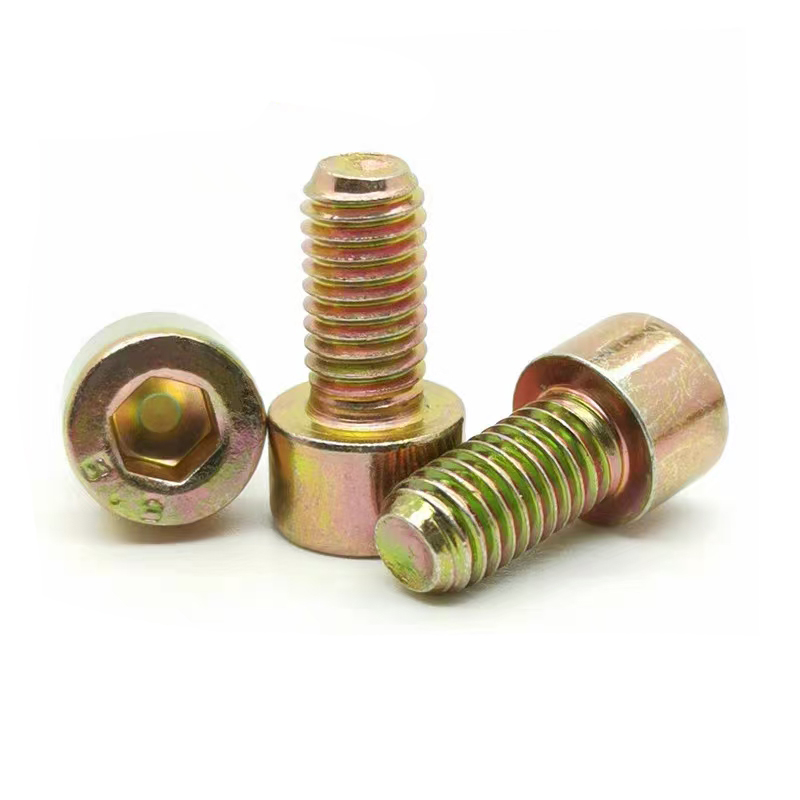
Cup head hex socket screws
You see 'cup head hex socket screw' on a drawing or a procurement list, and it seems straightforward—a screw with a cylindrical head and a hex drive. But in the shop or on-site, that's where the real story begins. A lot of folks, even some seasoned buyers, conflate them with standard socket cap screws or button heads, not realizing the specific niche these fasteners occupy, particularly when you need that low-profile, flush-to-counterbore fit with the torque capability of a hex key. It's a detail that can trip up a project.
The Anatomy of a Reliable Fixing
The defining feature, obviously, is the head. The cup head, sometimes called a cup head hex socket screw, provides a larger bearing surface than a standard flat head, but with a much lower profile than a socket cap. This isn't just about looks; it's about load distribution in thin materials or pre-counterbored holes. The hex socket drive is the workhorse here—Allen key drive. It gives you superior torque transfer compared to Phillips or slotted, crucial for high-clamp applications. But the devil's in the angles: the transition from the head's chamfer to the cylindrical body, and the depth and finish of the socket itself. A poorly machined socket will round out, leaving you with a nightmare extraction job.
Material and heat treatment are non-negotiable talking points. For most industrial uses, you're looking at alloy steel, grade 12.9 or similar, and proper black oxide or zinc plating. I've seen batches where the plating was too thick, affecting the thread fit, or the heat treatment was off, leading to brittle failures under tension. You can't judge this by a photo on a website; it often comes down to the manufacturer's process control.
This is where sourcing becomes critical. The production hub in Yongnian, Handan, Hebei, is where a significant volume of the world's standard parts originate. A manufacturer based there, like Handan Zitai Fastener Manufacturing Co., Ltd., inherently has access to the material streams and specialized machining ecosystem of that region. Their location adjacent to major transport routes isn't just a sales point; it translates to logistical efficiency for bulk orders, which matters when you're managing project timelines. You can find their specifics at https://www.zitaifasteners.com.
Application Pitfalls and Field Observations
Where do these screws typically earn their keep? Machinery assembly, especially where space around the fastener is tight but you need a flush finish. Think enclosures, gearbox housings, or mounting plates on precision equipment. The common mistake is undersizing the counterbore. The cup head is designed to sit flush, not proud. If the counterbore depth or diameter is even half a millimeter off, the head protrudes, defeating its purpose and potentially causing interference.
Another practical note: thread length selection. Unlike a standard cap screw where you might have more leeway, with a cup head hex socket screw, the unthreaded shank length under the head is critical. You need enough grip length to engage the material fully before the threads start, ensuring the clamp force is applied correctly. I recall a retrofit project where we used off-the-shelf cup heads, and the shank was too short, causing the joint to loosen under vibration. We had to switch to a custom-length batch.
Drive tool fit is a daily frustration. Using a worn or slightly undersized Allen key is the fastest way to strip a socket. The tolerance between the key and the socket needs to be precise. High-quality screws from reputable sources tend to have tighter, cleaner sockets. It's a small detail that saves hours of labor.
Sourcing and the Quality Verification Dance
Ordering from a catalog or a site like Zitai's is step one. The real test is the sample batch. We always run our own checks: hardness test on a sample, salt spray test on the plating, and a simple torque-to-failure test. For cup head hex socket screws, we pay extra attention to the socket depth. A shallow socket is a major red flag—it won't engage the key fully and will fail prematurely.
Communication with the manufacturer is key. When you're dealing with a company situated in a major production base like Yongnian, they should be able to speak to the specifics of their cold forging process, their raw material sourcing, and their QC thresholds. Generic answers are a warning sign. The good ones can discuss the advantages of their thread rolling versus cutting, or their specific oxide coating formulas for corrosion resistance.
Volume plays a role. For large, repetitive projects, establishing a spec with a trusted supplier becomes invaluable. It moves the conversation from commodity purchasing to a partnership on specifications, which minimizes on-site failures. The logistical advantage of a producer located near major highways and rail, as noted in Zitai's profile, becomes a tangible benefit here, ensuring consistent supply chain flow.
When Alternatives Creep In (And When They Shouldn't)
There's always pressure to substitute. A purchasing agent might see a cheaper button head or flat head screw. Sometimes it's fine. Often, it's not. The button head has a rounded top, which protrudes more. The flat head requires a conical counterbore, which is different machining. The cup head's value is its specific combination of low profile, flat bearing surface, and robust drive.
We tried substituting with a standard socket cap on a panel once. The increased height caused clearance issues with a sliding cover. It was a simple design, but the oversight cost us a rework. That's the lesson: the cup head hex socket screw is a solution to a specific set of geometric and mechanical constraints. It's not always interchangeable.
In corrosive environments, the material spec becomes even more vital. Switching from a standard zinc plating to a more robust dacromet or geometric coating might be necessary, and not all manufacturers offer that flexibility. It's a conversation you need to have upfront.
Concluding Thoughts from the Toolbox
So, it's never just about the keyword. It's about understanding the why behind the spec. The cup head hex socket screw is a precision tool for a specific job. Its effectiveness hinges on the nuanced quality of its manufacture—the socket depth, the heat treatment, the plating—and a correct understanding of its application geometry.
Sourcing from a specialized manufacturer embedded in a production cluster, such as the one in Handan Yongnian, offers advantages in consistency, cost, and logistics, but it doesn't absolve you from due diligence. Always test samples. Always specify clearly.
In the end, the best fastener is the one you don't have to think about after it's installed. It just works. Getting to that point with a component as seemingly simple as a cup head screw requires a blend of good design, informed sourcing, and practical, hands-on verification. That's the difference between a smooth assembly and a field service call.
Ki gen rapò pwodwi
Pwodwi ki gen rapò
Pi bon vann pwodwi
Pi bon pwodwi vann-
 Boulon charnyèj
 - Boulon panyen
- Nwa zenk plake arbr peny
- Boulon bride ki gen koulè pal
- Bolt cha (mwatye wonn tèt kare kou boulon)
- Elektwo-galvanised countersunk boulon kwa
- Anchor plak soude (soude plak jete lank)
- Plak Electrogalvanized Embedded
- Electrogalvanized Cross Countersunk Drill Fil
- Koulè Zenk-plake kwa kontwar fil fè egzèsis
- Anti-lyen nwa (bloke nwa)
- Nwa electrogalvanized