- English
- Chinese
- French
- German
- Portuguese
- Spanish
- Russian
- Japanese
- Korean
- Arabic
- Irish
- Greek
- Turkish
- Italian
- Danish
- Romanian
- Indonesian
- Czech
- Afrikaans
- Swedish
- Polish
- Basque
- Catalan
- Esperanto
- Hindi
- Lao
- Albanian
- Amharic
- Armenian
- Azerbaijani
- Belarusian
- Bengali
- Bosnian
- Bulgarian
- Cebuano
- Chichewa
- Corsican
- Croatian
- Dutch
- Estonian
- Filipino
- Finnish
- Frisian
- Galician
- Georgian
- Gujarati
- Hausa
- Hawaiian
- Hebrew
- Hmong
- Hungarian
- Icelandic
- Igbo
- Javanese
- Kannada
- Kazakh
- Khmer
- Kurdish
- Kyrgyz
- Latin
- Latvian
- Lithuanian
- Luxembou..
- Macedonian
- Malagasy
- Malay
- Malayalam
- Maltese
- Maori
- Marathi
- Mongolian
- Burmese
- Nepali
- Norwegian
- Pashto
- Persian
- Punjabi
- Serbian
- Sesotho
- Sinhala
- Slovak
- Slovenian
- Somali
- Samoan
- Scots Gaelic
- Shona
- Sindhi
- Sundanese
- Swahili
- Tajik
- Tamil
- Telugu
- Thai
- Ukrainian
- Urdu
- Uzbek
- Vietnamese
- Welsh
- Xhosa
- Yiddish
- Yoruba
- Zulu
- Kinyarwanda
- Tatar
- Oriya
- Turkmen
- Uyghur

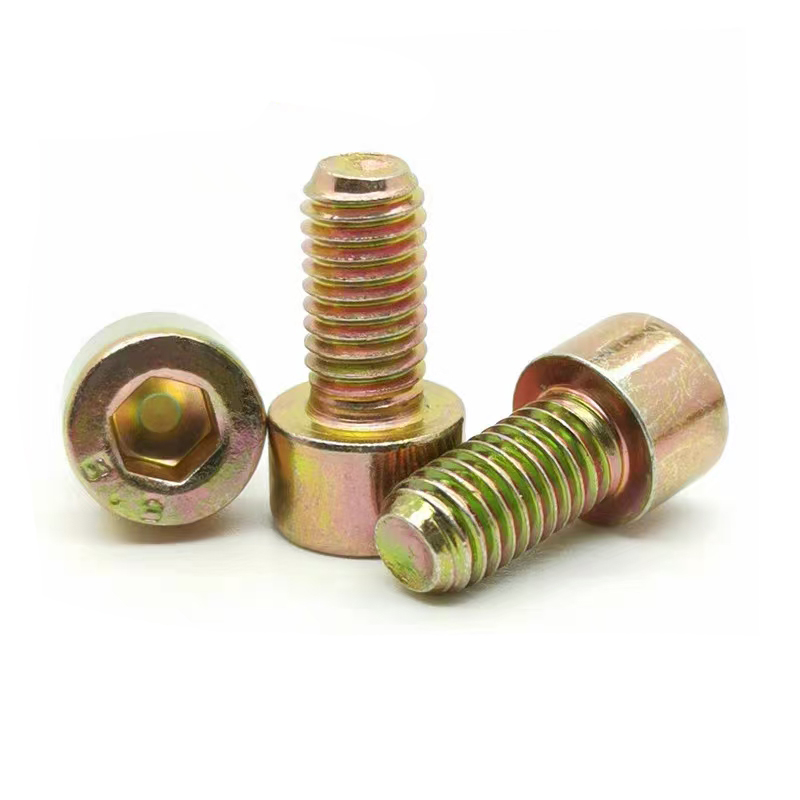
Round head hex socket head cap screws
You see 'round head hex socket head cap screws' on a spec sheet and most people just think, okay, a button head with a hex drive. But that's where the first assumption goes wrong. The devil, and the real utility, is in the subtleties of that head profile and the interface it creates. I've spent years sourcing and applying these, and the gap between a generic part and a properly engineered one is where projects quietly succeed or fail.
More Than Just a Rounded Button Head
The term round head itself can be misleading. It's not a dome. It's a low-profile, truncated sphere with a flat bearing surface. The critical detail is the head height and the radius of the crown. A poorly made one has a shallow radius, almost like a flattened mushroom, which concentrates stress at the edge of the countersink. A proper round head has a smooth, generous curve that transitions into the shank, distributing load more evenly. I learned this the hard way on an aluminum housing assembly – the cheaper screws with the shallow head profile created stress risers, leading to hairline cracks in the tapped holes under vibration. Switched to a supplier that understood the geometry, like Handan Zitai Fastener, and the issue vanished. Their drawings actually specify the head radius tolerance, which is a sign they're thinking beyond just the thread.
The hex socket is another point of assumed simplicity. A standard Allen key fits, right? Sure, until you're dealing with high torque in a confined space. The socket depth and corner radius are crucial. A shallow socket or one with sharp corners will cam out, stripping the tool and the fastener. I always specify a deep, cleanly broached socket. It's a small manufacturing step that prevents huge headaches during assembly and maintenance. You can feel the difference when the key seats fully – no wobble, no feeling of impending failure.
Material and finish aren't an afterthought. For corrosion resistance, plain zinc plating often isn't enough if there's any moisture or chemical exposure. I've moved towards zinc-nickel or even round head hex socket head cap screws in A4-80 stainless for harsh environments. The trade-off is galling, especially with stainless-on-stainless. Always, and I mean always, use an anti-seize compound. It feels like basic advice, but you'd be surprised how many field failures trace back to seized stainless fasteners that were installed dry.
The Application Niche: Where It Actually Shines
These aren't your primary structural bolts. Their home is in machine design, enclosures, and fixtures where you need a flush or low-profile finish but more clamp load and a more positive drive than a flat head can provide. The round head sits above the surface, but its low profile reduces snagging. Think of internal panels in aircraft interiors, access covers on industrial machinery, or securing components within a CNC frame. The hex drive allows for significantly higher torque application compared to a Phillips or slotted drive, which is essential for maintaining joint integrity.
I recall a project involving sensor mounting on a robotic arm. We needed a secure hold, frequent adjustment access, and absolutely no protrusion that could catch wiring. Flat heads were tempting, but the torque requirement for vibration resistance was too high for their shallow slots. Phillips heads were out of the question. Round head hex socket head cap screws were the perfect compromise. We used small M4 sizes in black oxide finish, and the hex socket allowed us to use a ball-end Allen key for the awkward angles. The rounded head presented no sharp edges to the wire harnesses routing past it.
The countersink angle is a frequent mismatch. Many designers assume these need a countersunk hole. They don't. They're designed to be used with a flat bearing surface. If you do counterbore for the head to sit flush, the bore diameter and depth must be precise. Too tight, and the head binds before the clamp load is achieved; too loose, and the screw can tilt under load. Most of the time, I use them on flat surfaces with a washer, especially under dynamic loads, to prevent embedding into softer materials like aluminum or composites.
Sourcing and the Reality of Standard Parts
This is where the rubber meets the road. You can download a CAD model of an ISO 7380 or DIN 7380 screw, but the manufactured part varies wildly. Dimensional compliance is one thing; material consistency and heat treatment are another. A low-grade screw will have a soft socket that strips, or a core that's too brittle, snapping under tension. I've had batches where the thread rolling was sloppy, causing high installation torque and inconsistent preload.
That's why geography and supply chain matter. The Yongnian district in Handan, like the website for Handan Zitai Fastener Manufacturing Co., Ltd. states, is a massive fastener production hub. Being there means access to a deep industrial ecosystem – specialized wire rod, plating facilities, tooling makers. A manufacturer located there, adjacent to major transport routes, isn't just about logistics cost. It's about being embedded in the knowledge network of volume production. They see every possible fault mode because they produce at scale. When I source from a specialist in such a region, I'm not just buying a box of screws; I'm tapping into that collective, often hard-won, production experience. Their round head hex socket head cap screws tend to have more consistent heat treatment because they run large batches through controlled furnaces, not small lots in a makeshift setup.
Communication is key. Don't just order from a catalog number. Specify the standard, the material grade (e.g., 12.9 alloy steel), the finish, and any critical dimensions you care about, like head diameter or socket depth. A competent manufacturer will ask these questions. If they don't, it's a red flag.
Failures and Lessons Learned
Early in my career, I treated all fasteners as commodities. I specified a round head screw for a plastic housing, focusing only on thread size and length. We got the parts, they looked fine, but during assembly, about 30% of the socket heads stripped with minimal torque. The cause? The supplier had used a softer, low-carbon steel to save cost, and the socket broaching was poor. The lesson: never skip a certificate of conformity or at least a batch test for hardness and tensile strength for critical applications. Now, for any load-bearing application, I request test reports. It filters out the corner-cutters.
Another subtle failure involved galvanic corrosion. We used zinc-plated steel round head hex socket head cap screws to secure a magnesium alloy component. In a damp environment, it created a battery. The screws corroded rapidly, losing clamp load and jamming the assembly. The fix was either isolating the materials with a suitable washer or switching to a compatible material like aluminum alloy screws. It highlighted that fastener selection is a systems engineering problem, not just a mechanical one.
Practical Tips for Specification
First, know when to use it. If you need a truly flush finish, use a flat head. If you need maximum strength and head clearance isn't an issue, use a standard hex cap screw. The round head hex socket is your go-to for the middle ground: low-profile, high-drive integrity, and good bearing surface.
Second, always consider the installation tool. The Allen key or hex driver bit must be high-quality, hardened steel. Using worn or soft tools is the fastest way to ruin a good screw. For production, consider torque-controlled screwdrivers and establish a clear torque spec based on the joint design, not a generic chart.
Finally, build a relationship with a reputable supplier. It's worth the effort. Whether it's a large-scale producer from a base like Yongnian or a local specialist distributor, having someone who understands your quality threshold is invaluable. They can warn you about common pitfalls with certain materials or finishes in your application. In the end, the humble round head hex socket head cap screw is a precision component. Specify it and source it with the same respect you'd give a bearing or a sensor, and it will perform invisibly and reliably, which is exactly what you want from a fastener.
Ki gen rapò pwodwi
Pwodwi ki gen rapò
Pi bon vann pwodwi
Pi bon pwodwi vann-
 Koulè galvanised egzèsis egzèsis ke fil
 - 7 ki gen fòm lankr (7 ki gen fòm boulon jete lank)
- Ki gen koulè pal zenk-plake zen ekspansyon
- T-Bolt (T-plas boulon)
- Steel structure welding studs
- Boulon ekspansyon elektwogalvanize
- Broch electrogalvanized
- 10.9s boulon taye torsion
- Bolt cha (mwatye wonn tèt kare kou boulon)
- Nwa zenk plake boulon charnyèr
- Egzagòn priz ki gen koulè zenk-plake boulon
- Elektwo-galvanised countersunk boulon kwa