- English
- Chinese
- French
- German
- Portuguese
- Spanish
- Russian
- Japanese
- Korean
- Arabic
- Irish
- Greek
- Turkish
- Italian
- Danish
- Romanian
- Indonesian
- Czech
- Afrikaans
- Swedish
- Polish
- Basque
- Catalan
- Esperanto
- Hindi
- Lao
- Albanian
- Amharic
- Armenian
- Azerbaijani
- Belarusian
- Bengali
- Bosnian
- Bulgarian
- Cebuano
- Chichewa
- Corsican
- Croatian
- Dutch
- Estonian
- Filipino
- Finnish
- Frisian
- Galician
- Georgian
- Gujarati
- Hausa
- Hawaiian
- Hebrew
- Hmong
- Hungarian
- Icelandic
- Igbo
- Javanese
- Kannada
- Kazakh
- Khmer
- Kurdish
- Kyrgyz
- Latin
- Latvian
- Lithuanian
- Luxembou..
- Macedonian
- Malagasy
- Malay
- Malayalam
- Maltese
- Maori
- Marathi
- Mongolian
- Burmese
- Nepali
- Norwegian
- Pashto
- Persian
- Punjabi
- Serbian
- Sesotho
- Sinhala
- Slovak
- Slovenian
- Somali
- Samoan
- Scots Gaelic
- Shona
- Sindhi
- Sundanese
- Swahili
- Tajik
- Tamil
- Telugu
- Thai
- Ukrainian
- Urdu
- Uzbek
- Vietnamese
- Welsh
- Xhosa
- Yiddish
- Yoruba
- Zulu
- Kinyarwanda
- Tatar
- Oriya
- Turkmen
- Uyghur

Round head machine screws
You see 'round head machine screws' on a spec sheet and think, 'simple dome, slotted or Phillips, got it.' That's the first trap. In the real world of assembly, that assumption can cost you time, money, and a lot of frustration when the part doesn't perform. It's not just a shape; it's a set of compromises between grip, clearance, tool engagement, and final appearance that a lot of procurement folks, frankly, gloss over until they're holding a stripped head or dealing with a fit-up issue on the line.
The Profile is the Point
Let's get specific. The classic round head machine screw has a hemispherical head with a flat bearing surface underneath. The key isn't the dome you see, it's that flat underside. It's designed for countersunk holes? No, not really. That's a common mix-up with oval head screws. The round head sits on top of the workpiece. That means you need adequate clearance above the surface. I've seen designs where the engineer specified a round head for a recessed cavity, only to find the assembly tool couldn't get a straight angle on the drive because the dome was hitting the cavity wall. Rework city.
The head height and diameter ratio matters more than you'd think. A shallow, wide dome offers a lower profile but a smaller drive socket size, risking cam-out. A taller, narrower dome gives you a deeper drive recess (good for torque) but protrudes more. For something like securing a nameplate or a thin gauge cover where you want a smooth, finished look but can't countersink the base metal, the round head is the go-to. But you must pair it with a washer if the substrate is soft, or that flat bearing surface will just dig in.
Material choice plays into this too. In stainless steel, especially the 300 series, the metal can gall. If you're driving a stainless steel round head machine screw into a stainless steel nut or tapped hole without the right lubricant or coating, you might weld the thing in place before you hit spec torque. A lesson learned the hard way on a marine fixture job. We switched to a zinc-plated carbon steel screw for the application, problem gone. The head shape didn't change, but the material context made all the difference.
Drive Types and the Grip Reality
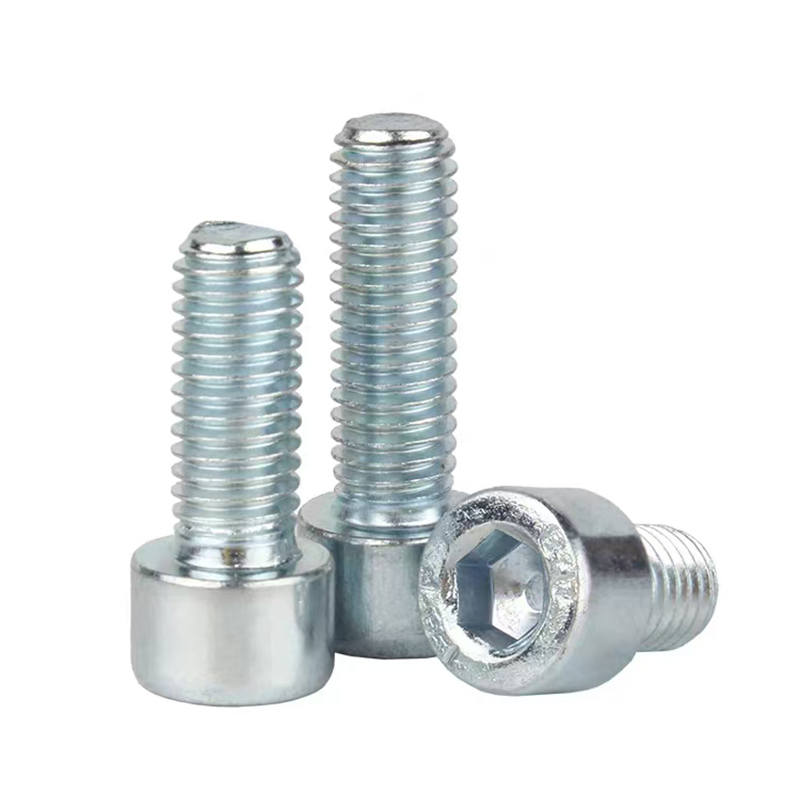
Slotted, Phillips, Pozidriv, Allen (socket cap). The drive type is married to the head. The old-school slotted round head is a nightmare for production. Your driver slips, scars the dome, and looks terrible. Phillips is better but still prone to cam-out under high torque. For any serious assembly, you want a socket drive. But here's the catch: a socket (Allen) drive in a round head means a smaller hex key size compared to a socket head cap screw of the same body diameter, because the walls of the socket have to fit within the dome's curvature.
This leads to a very practical sourcing issue. You need a higher-grade alloy steel for the screw to achieve the required clamp force without stripping the internal hex. I recall a batch from a supplier that shall remain nameless where the hex socket depth was under-machined by just half a millimeter. The key wouldn't seat fully, it stripped on the first drive attempt, and we had to manually inspect and reject 20,000 units. The failure wasn't in the thread or the tensile strength; it was in that tiny, often overlooked, drive feature.
That's why when you find a supplier that gets these nuances right, you stick with them. A place like Handan Zitai Fastener Manufacturing Co., Ltd., based in China's major fastener hub in Yongnian, Hebei, understands this on a production scale. Their location near major transport routes isn't just a sales point; it means they're embedded in a supply chain ecosystem where these specs are debated daily on factory floors. Checking their catalog at zitaifasteners.com, you can see the attention to drive specification and head profiling even on standard items. It's that granular level of control that separates a commodity vendor from a manufacturing partner.
The Finishing Problem No One Talks About
Plating and coating. A round head, with its continuous curved surface, is actually tougher to plate evenly than a flat-headed screw. Electroplating tends to build up on edges and corners. On a round head, the 'edge' is the entire circumference where the dome meets the shank. You can get a noticeable ridge or a thin spot there. For decorative applications or where corrosion resistance is critical, this is a real concern.
We had a project for outdoor enclosures using zinc-flake coated (Geomet) round head screws for a uniform black finish. The first samples were perfect. The production run showed a slight variation in sheen and thickness around that head-to-shank junction. It was subtle, but under certain light, the fastener looked 'ringed.' The coating vendor blamed the screw geometry; the screw maker blamed the coating process. The solution? Adjusting the racking density and agitation during coating for that specific part geometry. It added a week to the lead time. Now it's a line item in our spec: Coating uniformity must be maintained over full head profile.
This is where the manufacturing base of a company like Zitai becomes relevant. Being in Yongnian, they have immediate access to a network of plating and treatment specialists. They can troubleshoot these process-level issues because they see volume and variety. A smaller, isolated shop might not have that ecosystem to lean on.
When to Use It (And When to Run)
So after all this, where does the round head machine screw earn its keep? It's ideal for attaching components to a surface that cannot be modified with a countersink. Think about mounting a hinge plate to a wooden door frame, or securing a metal bracket to a stone or concrete surface (with an anchor, of course). The dome provides a finished look that's less snag-prone than a pan head. It's also useful in electrical enclosures where a smooth head is safer and less likely to catch wiring.
When should you avoid it? When you need a flush finish (use a flat or oval head). When you need very high torque and minimal protrusion (a socket head cap screw is better, though it sticks up more). When you're assembling brittle materials like certain plastics or composites—the concentrated bearing force of that flat underside can crack the material. Always use a washer or a larger bearing surface.
The takeaway is to never treat it as a generic fastener. Its value is in its specific geometry for specific situations. Specifying it correctly—with the right drive, material, plating, and a clear understanding of the assembly context—is what separates a functional design from one that has to be constantly reworked in the field. It's a small part, but like all things in mechanical design, the devil is in the details you only learn by getting them wrong first.
Ki gen rapò pwodwi
Pwodwi ki gen rapò
Pi bon vann pwodwi
Pi bon pwodwi vann-
 Boulon panyen
 - Ki gen koulè pal zenk-plake zen ekspansyon
- Boulon chimik elektwogalvanize
- Parapli manch jete lank (J-tip jete lank boulon/parapli manch anbale boulon)
- Egzagòn Socket Electrogalvanized boulon
- Bolt cha (mwatye wonn tèt kare kou boulon)
- Nwa soude (nwa soude)
- Boulon egzagonal cho-tranpe
- Anti-lyen nwa (bloke nwa)
- Nwa zenk plake arbr peny
- Electrogalvanized Cross Countersunk Drill Fil
- Boulon papiyon